History - Sally Lunn, the original Bath Bun & the Oldest House in Bath

In a nutshell....

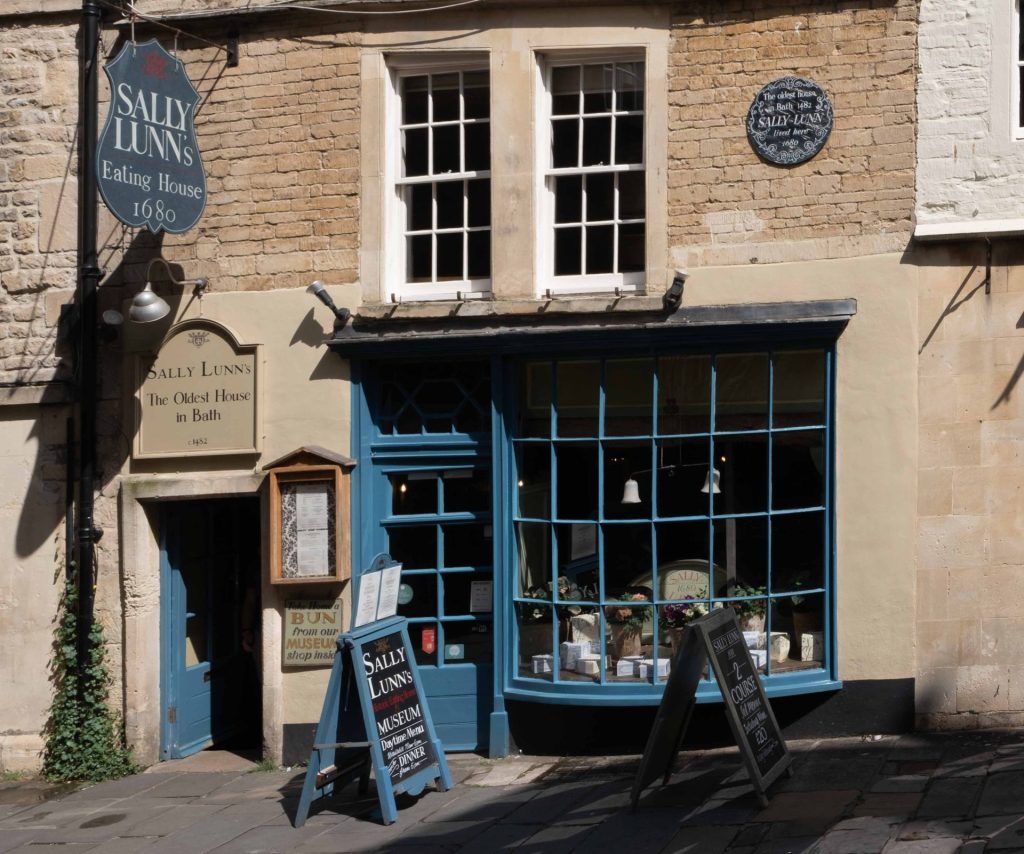
Sally Lunn, a young French refugee, arrived in England over 300 years ago. She found work at what is now known as Sally Lunn's House and began to bake a rich round and generous bread now known as the Sally Lunn Bun. This bun became a very popular delicacy in Georgian England as its special taste and lightness allowed it to be enjoyed with either sweet or savoury accompaniments. Many attempts have been made to copy our world famous Bun with little success. The story of Sally Lunn's House starts long before the arrival of Sally Lunn in 1680 - our museum shows the history of Bath's oldest house many hundreds of years before the current timber framed construction - when you visit you will see the Roman and Medieval foundations of the house and finds from excavations. You will also see the original kitchen that was used by Sally Lunn. You can see images of the museum in our photo gallery
The original 'Bath Bun' is in fact The Sally Lunn Bun – so bun is which?

The Sally Lunn Bun is the Original Bath Bun.

It is a rich round and generous brioche bun’ similar to the historic French festival ‘breads’. Sally Lunn, a Huguenot refugee (perhaps better known as Solange Luyon) came to Bath in 1680 via Bristol after escaping persecution in France. In Lilliput Alley she found work with the baker and introduced her now famous light and delicate ‘bun’ to pre Georgian Bath. Sally’s fame, together with that of her bun grew and grew alongside that of the city of Bath. Versions of the Sally Lunn Bun can be found around the world in Canada, The United States, New Zealand and Australia. Further, even in the UK attempts have been made to copy the original Sally Lunn Bun. The original and very secret recipe is passed on with the deeds to Sally Lunn’s house and is still made by us by hand.

All things evolve and become copied over time. Recipes claiming to be similar to Sally Lunn buns can be found in publications dating back to early in the eighteenth century.

Elizabeth David, who wrote the definitive book: English Bread and Yeast Cookery in 1977, suggests from her extensive research that Sally Lunn Buns with their delicate and light personality “differed greatly from a version downgraded by bakers into the amorphous, artificially coloured, synthetically flavoured and over-sugared confections we know today. This London Bath bun should, I believe, be distinguished from the Bath Bun of Bath”

The ‘London’ Bath Bun

It is suggested that the Great Exhibition of 1851 gave birth to the ‘London’ Bath bun. Records show that 943,691 ‘Bath buns’ were consumed over the 5½ month exhibition period. It is widely agreed that a few corners were cut to create such a large amount of buns and reports of their poor quality were widespread.

It seems that the stage granted to the ‘London bath bun’ gave it life and again gave birth to many copies. Over the last 40 years or so, the bun many people have come to call different versions of this ‘London Bath bun’ a ‘Bath bun’ which is a shame because unlike Sally Lunn Buns they are small, doughy / stodgy and overpoweringly sugared. They also keep miserably.

However, if you have a very sweet tooth and can get a good ‘London Bath bun’ straight out of the oven they can be OK.

The story of the Oldest house in Bath

The story of Sally Lunn's House starts long before the arrival of Sally Lunn in 1680. Excavations in the cellar's of this timber framed building, firstly in the 1930s and more recently in 1985 have produced many finds dating back through Bath's history to Roman times.The excavations on display in the north cellar reveal, at the deepest level, the Roman occupation. Here many box flue and other tiles have been found from a hypocaust (underfloor central heating system) together with tesserae from floor mosaics, painted plaster from the walls, roof tiles and pieces of high quality Samian pottery.A particularly exciting discovery was the painted rim of a mortarium (mortar) designed for teasing the flavour from aromatic plants.Without doubt there was a Roman building on this site in which food was prepared and eaten. Located so conveniently close to the Roman baths it could have been a Roman inn for travelers.This would take our tradition of hospitality and refreshment back nearly 1800 years, to the period when the hot springs and the temple of the goddess Sulis Minerva attracted visitors from all over north-west Europe.

In 1091, William II granted the city and Saxon abbey of Bath to his former chaplain and doctor, John de Villula, Bishop of Wells.
The see was transferred to Bath and work began on a massive cathedral priory, complete with bishop's palace. Sadly, in 1137 his glorious buildings were devastated by a fire that ran through the whole city.The abbey complex was rebuilt at great expense by Bishop Robert of Lewis (1137 - 66), including the church, chapter house, cloister, dormitory, refectory and infirmary. The southern range of the buildings, now under Sally Lunn's House, would have contained the refectory and kitchen of the Benedictine monastery.In the north cellar of Sally Lunn's House; visitor's can see the foundations, floor and stone walling of part of this medieval complex. The low stone wall stands on a rubble foundation and served to raise the large lower timbers of the walls off the ground. The building was occupied for centuries. Seven separate floor levels have been discovered, each containing bone pottery debris.A prize exhibit is part of a fine green glazed face Jug made at Laverstock, near Salisbury. The lowest floor level can be dated to around 1150 and rests on rubble containing rich pink burnt stone from the fire of 1137.

The Faggot oven was constructed outside the kitchen on the earliest medieval floor level with its mouth just projecting into the building.The bread oven is of a design which originated in Rome around 100 B.C. and was still the normal type of construction until the early 17th century.Faggot ovens were large low stone or brick chambers into which tightly tied bundles of thin branches - faggots - were pushed, one each side and one or two at the back, and then set alight.The oven door or stop made of clay, iron or timber was set at an angle into the oven mouth, the top leaning outwards, the bottom inwards. This allowed air to be drawn in at the floor for the wood to burn, and the smoke to escape at the top.Once the faggots had burned to ash, the hot embers were raked out, the oven floor or sole was swept clean with a scuffle (a wet sack cloth swinging on the end of a pole) and the heat stored in the stone would be sufficient for baking bread. Bread was a staple and vital part of everyone's diet. The abbey dominated the city during the medieval period. When King John visited Bath in 1207 the clergy and religious were said to be one - third of the population and the church grounds to cover one - quarter of the city. We can speculate that King John ate bread baked in our Faggot Oven.

Traditionally a date of 1482 had been ascribed to this house, which probably refers to a rebuilding of the fireplaces and chimneys of the parlour adjacent to the refectory during the monastic period. Bishop Beckynton (1443 -65) is known to have built a new dormitory for the monks and it is possible that other rebuilding, of which we have no documentation, was carried out a little later, becoming the source of this well established tradition.

Henry VIII, in 1539, dissolved the monasteries and dispersed their lands. The Bath Abbey precinct came into the hands of the Colthurst family, but in 1612. Henry Colthurst sold this quarter of the city to wealthy John Hall of Bradford on Avon. George Parker, a carpenter, was granted a building lease by John Hall in 1622. He built the present timber framed house on the substantial remains of the south side of the former abbey.

The timber for it was most probably sawn in sawclose, then a timber yard in the northeast corner of the walled city, where he rented a plot from the city council. George Parker was clearly a fine craftsman, whose work has stood the test of time. The faggot oven and old downhearth were incorporated in the ground floor of the building. Food would nave been cooked here in the open hearth with a wood burning fire. Other rooms in the house have decorative fireplaces in the Tudor style still popular in the 1600s.

Sally Lunn's House is a unique reminder of pre-Georgian Bath. It is powerfully evocative of the atmosphere of the ancient walled city, illustrated by Gilmore's fine map of 1694 showing Bath's narrow alleys and gabled roofs. Sally Lunn's is set in the narrow street long known as Lilliput Alley, before becoming North Parade Passage. It was the city Beau Nash would have seen on his arrival in 1705. This was the start of the century that saw the old Bath swept away and replaced by the splendour of Georgian squares, terraces and crescents in the Palladian style favoured by John Wood. The house has not been greatly altered, but certain changes have been made since it was built. During the 1700s, the street level was raised, making the original ground floor into a cellar. A grand reception room was created on the new ground floor by replacing a dividing wall with an elegant Hanoverian arch. The oven and kitchen fireplaces were kiht}tchen fireplaces were modernized to burn coal.

In 1660 Charles II was restored as king and the somber dress and style of Cromwell gave way to a lighthearted and more joyous mood. Bath became a fashionable resort. In 1668 Samuel Pepys the famous diarist came to the city and enjoyed the mixed bathing. The merry Monarch Charles II paid a visit too and with this influx of the wealthy and fashionable, tradespeople Flourished. Legend has it that from her home in France, where the Protestant Huguenots were being cruelly persecuted, came young Sally Lunn to find employment with a baker who rented premises in Lilliput Alley. She sold his wares in the street, but when her skill at baking Brioche was discovered she no doubt spent for more time in the bakery itself. Sally Lunn's Buns were a tremendous success; others tried hard to copy them, but her skill with the rich, soft and delicate dough inspired customers specifically to request the Sally Lunn.

In the latter half of the 1700s, the famous Spring Gardens drew the fashionable throng across the river to the public and private breakfasts that were one of the delights of Bath. A particular attraction were the hot, buttered Sally Lunn's, as advertised in the Bath Chronicle. Clearly mere prose could not do justice to such a gastronomic pleasure. When Spring Gardens closed down in August 1798, it would appear that exclusive rights to Sally Lunns recipe were bought by the baker William Dalmer, who began advertising Sally Lunn's the following year. He sent them out warm every morning in a portable oven made for the purpose, with instructions that they should be cut with a sharp knife and spread with melted butter. Dalmer combined baking with song writing and went one better than a verse: A Much Admired Duett' to extol his prize product.

The reputation of the Sally Lunn was undimmed in the Victorian period. It found its way into the Gilbert and Sullivan operetta The Sorcerer while Charles Dickens wrote 'Sally Lunn the illustrious author of the tea cake' in Chimes. Meanwhile, in 1743 the duke of Kingston, who had acquired all the land of John Hall, sold Sally Lunn's House to William Robinson and the legal documents from this transaction can be seen today displayed on the walls. The house subsequently saw a number of interesting occupants come and go, busily engaged in the luxury trades that catered to Bath's wealthy visitors.

From 1781 to 1786 James Wicksteed operated here as a seal engraver. His father John had pioneered a water powered seal engraving machine, based for decades in Widcombe, where the Wicksteed Machine became one of the local sights.

During this period the bakery may been in use in a small way,but from around the turn of the century baking became the main commercial use of the property and remained so for over a hundred years. It went through the hands of a number of families: Turner,Windsor, Philips, Bush, Fricker, Page, Townsend and finally Culverhouse. Edward Culverhouse was the baker here from 1903 until he emigrated with his family to Australia in 1919. The Culverhouses were followed by the Griffiths, who used the ground floor as a general store, renting out the rooms above. The building became run down and in desperate need of restoration.


Eventually this loving touch was bestowed by Marie Byng-Johnson, who preserved both the house and its romantic associations after she took over in 1937. She carried out extensive restoration, during which time Sally Lunn's recipes were discovered in a secret cupboard in the old paneling which can still be seen today. She was an artist, who was charmed by the bow window, which seemed to her an ideal place to exhibit her delightful cards of old Bath. These cards can still be sent today.

Scene from Georgian cafe society